Linggo, Setyembre 4, 2016

Court decision on Filemon Lagman case

[G.R. No. 141704. June 7, 2000]

HON. ORLANDO S. MERCADO, et al. vs. EDCEL LAGMAN, et al.

THIRD DIVISION

Gentlemen:

Quoted hereunder, for your information, is a resolution of this Court dated JUN 7 2000.

G.R. No. 141704 (Hon. Orlando S. Mercado, Hon Reuben P. Dela Cruz, Asst. Provincial Prosecutor Apolinario Bruselas, Jr. and State Prosecutor Archimedez Manabat, et al. vs. Edcel C. Lagman and Filemon Lagman.)

Petitioners assail the decision of the Court of Appeals affirming the decision of the Regional Trial Court which disposed thusly:

WHEREFORE, premises considered and pursuant to the mandate granted by the Honorable Supreme Court in its Resolution dated November 18, 1996, it is the decision of this court based on evidence, the law and jurisprudence:

1. To issue a writ of certiorari annulling and setting aside the criminal Information filed in Criminal Case No. 96-1369 MK and the warrant of arrest issued by the respondent court pursuant to said criminal information;

2. To issue a writ of injunction enjoining the respondent court from further proceeding with Criminal Case No. 96-1369 MK;

3. To declare the detention of petitioner Filemon Lagman illegal; to direct the immediate release from detention of petitioner Filemon Lagman in connection with Criminal Case No. 96-1369 MK unless the petitioner is being held pursuant to some other lawful cause or authority;

All the respondents shall be collectively responsible in enforcing the immediate release from detention of petitioner Filemon Lagman

In compliance with the directive of the Honorable Supreme Court, furnish a copy of this decision immediately to the Honorable Supreme Court.

The instant controversy sprung from a letter complaint which was referred by the Presidential Task Force on Intelligence and Counter Intelligence (PTFIC) to the Department of Justice (DOJ), for appropriate action, involving a case for violation of Article 248 (murder) of the Revised Penal Code against Filemon Lagman alias Ka Popoy and seven others, in connection with the ambush slaying of a traffic policemen in Marikina on March 30, 1992.

Attached to the subject letter-complaint are the sworn statements (karagdagang sinumpaang salaysay) of Jose Alvarez dated April 9, 1996 and Rodrigo Porsona also of the same date; the sworn statement of Arthur Oquendo dated March 13, 1992 and his supplemental sworn statement dated June 27, 1996; the Affidavit of PO1 Bonifacio Simbulan PN dated June 27, 1996; the medico-legal report (No. M-052992) dated April 3, 1992; and, the investigation report of SPO1 Ronito L. Villareal dated March 30, 1992,

The DOJ then assigned a three-man investigating panel which in turn issued a subpoena to Filemon Lagman, informing him that a complaint has been filed against him by the PTFIC; commanding him to appear at the DOJ on July 22, 1996 at 2 p.m. for preliminary investigation; and ordering him to submit his counter-affidavit and other supporting documents in his defense, with a warning that failure on his part to submit his counter-affidavit shall be considered as waiver to present his defense in the preliminary investigation resulting in the case being considered submitted for resolution.

On July 22, 1996 setting for preliminary investigation, only counsel of private respondent Filemon Lagman appeared and requested that the defense be given ten days within which to submit its counter-affidavit. That same day, the preliminary investigation was reset to August 2, 1996.

On August 2, 1996, Filemon Lagman, through his lawyer, submitted a verified Motion to Dismiss, explicitly stating that such motion is not intended to be in lieu of his counter-affidavit, and should also not be considered as a waiver of all other legal remedies available to him. The motion to dismiss assailed the jurisdiction of the investigating panel to take cognizance of the referral letter-complaint of the PTFIC dated June 28, 1996. Likewise, it was argued that the letter-complaint of General Libarnes of the PTFIC was not sworn to before an officer authorized to administer oaths as required by Section 3(a), Rule 112 of the Rules of Court. The absence of the verification, it was claimed is fatal, such requirement being mandatory and jurisdictional.

The state prosecutors, did not resolve the motion to dismiss. On the other hand, Filemon Lagman, while waiting for action on his motion to dismiss, did not submit his counter-affidavit. On November 6, 1996, the state prosecutors promulgated their resolution recommending the filing of a criminal information against Filemon Lagman, et al. Said resolution did not bear the signature of 2nd Assistant Provincial Prosecutor Apolinario D. Bruselas, Jr. Nevertheless, it was approved by Assistant Chief State Prosecutor Nilo C. Mariano who signed for the Chief State Prosecutor.

The Information was raffled to Branch 272 of the regional Trial Court of Marikina. On November 8, 1996, a warrant of arrest was issued for Criminal Case No. 96-1369 MK against Filemon Lagman.

Pursuant to said warrant of arrest, Filemon Lagman was arrested and detained by the combined teams of the PTFIC and agents of the National Bureau of Investigation (NBI) on November 12, 1996. On November 14, 1996, Filemon Lagman, et al., filed with this Court a petition for Habeas Corpus and Certiorari with a prayer for a restraining order and/or preliminary injunction. Acting on said petition, the Court issued a resolution on November 18, 1996, stating:

Acting on the petition for Habeas Corpus dated November 14, 1996, the Court resolved:

a) to ISSUE the Writ of Habeas Corpus;

b) to RETURN the writ to the Executive Judge of the RTC not later than November 20, 1996;

c) to ORDER the executive Judge of the RTC-Quezon City to conduct an immediate raffle to SET the case for HEARING not later than Thursday November 21, 1996 at 8:30; try and decide the same on the merits and therefore FURNISH this Court with a copy of the decision thereon;

d) the respondents to make a RETURN of the writ on or before the close of office hours on Wednesday, November 20, 1996 and APPEAR PERSONALLY and produce THE PERSON OF Filemon Lagman on the aforesaid date and time of hearing;

The executive judge of the RTC of Quezon City accordingly raffled off the case on November 20, 1996 to Branch 221 of the same court which proceeded to hear the case on the merits and thereafter rendered the decision, the dispositive portion of which we earlier quoted.

Recourse to the Court of Appeals proved to be unavailing. Thus, the instant petition.

Initially, the Court notes that the petition was filed 2 days beyond the 30-day extension granted by us which fell on March 13, 2000, even as petitioners asked for an extension of only 15 days. On this score alone, the petition may be outrightly denied.

Petitioners insist that the ruling of the Court of Appeals that a murder complaint for purposes of preliminary investigation with the prosecutor must be verified or sworn to is contrary to law and jurisprudence. Likewise, petitioners claim that the Court of Appeals erred in holding that the preliminary investigation on the case against respondent was flawed on the ground that the investigating panel did not act on private respondent's motion to dismiss but instead promulgated the resolution recommending the filing of a criminal information; and in finding that the constitutional and fundamental right of respondent Filemon Lagman to due process was violated in the preliminary investigation of the complaint against him.

In regard to the first assigned error, the Court agrees with the Court of Appeals that it can not give credence to the petitioners' contention that the letter-complaint filed by the PTFIC need not be verified or sworn to before a person authorized to administer oaths.

Section 3 of Rule 110 of the Rules of Court clearly supports the stand of the Court of Appeals:

Sec. 3. Complaint defined. - Complaint is a sworn written statement charging a person with an offense, subscribed by the offended party, any peace officer or other public officer charged with the enforcement of the law violated.

Anent the second issue, the Court notes that when private respondent Filemon Lagman filed the motion to dismiss, a manifestation was made where he expressly reserved his right to file a counter-affidavit in the event that his motion to dismiss is denied. But, despite such manifestation, petitioners did not act on the motion to dismiss. Instead, they promulgated the November 6, 1996 resolution recommending the filing of a criminal information against Filemon Lagman, et al., violating private respondents' right to a preliminary investigation.

A preliminary investigation is required for offenses cognizable by the regional trial court under the procedure provided in Rule 112 of the Rules of Court. This procedure is to be observed in order to assure that a person is accorded due process.

It is a basis tenet that when the law provides for preliminary investigation and such right is claimed by the accused, a denial thereof is a denial of due process.

Consequently, the warrant of arrest which was issued pursuant to a flawed information is likewise fatally flawed. True it is, Section 6, Rule 112 of the Rules of Court provides that upon the filing of an information, the RTC may issue a warrant for the arrest of the accused. However, in the case at bar, where the information is defective for lack of a valid complaint and preliminary investigation, no warrant of arrest may validly spring therefrom. Further, any arrest made pursuant to such invalid warrant is, perforce, unlawful; any detention, illegal. It bears stressing that a flawed proceeding cannot ripen into a valid warrant of arrest nor detention.

The Court has ruled that it is axiomatic that where a deprivation of a constitutional right is established, the Court that rendered the judgment is deemed ousted of jurisdiction and habeas corpus is the remedy to assail the legality of the detention (Gumabon vs. Director of Bureau of Prisons, 37 SCRA 420).

WHEREFORE, petition is denied due course.

SO ORDERED.

Very truly yours,

JULIETA Y. CARREON

Clerk of Court

Biyernes, Pebrero 6, 2015

Pamana ni Ka Popoy

PAMANA NI KA POPOY
ni Gregorio V. Bituin Jr.
11 pantig bawat taludtod

lumipas ang labing-apat na taon
ngunit aral mo'y sa diwa bumaon
habang namamahinga ka na roon
patuloy kaming nagrerebolusyon

kaya, Ka Popoy, hindi ka nawala
nariyan pa ang mga manggagawa
pinagpapatuloy ang iyong diwa
diwang hindi nailibing sa lupa

haligi ka ng sambayanang api
ng mga obrero't simpleng kawani
pagkat naiwan mong akda'y nagsilbi
sa manggagawang sa mundo'y kayrami

nasa langit ka man, buwan, o laot
malalalim na tanong ay nasagot
katwirang sa salapi'y bumaluktot
mga trapong may sakit na kurakot

pagkat mga akda mo kung basahin
pamana mo'y madaling unawain
sinliwanag ng araw ang sulatin
paliwanag mong kaysarap namnamin

saan ka man naroroon, Ka Popoy
binhing inihasik mo'y di naluoy
nag-ugat, nagbunga itong patuloy
at sanga-sanga itong sumusuloy

mga akda mo'y walang kamatayan
ikaw na lingkod ng sangkatauhan
gabay sa pagbabago ng lipunan
ang sosyalismong iyong tinanganan

6 Pebrero 2015

Huwebes, Mayo 22, 2014

Ka Popoy Lagman, binigyang-pugay sa ika-4 na Kongreso ng NCL

KA POPOY LAGMAN, BINIGYANG-PUGAY SA IKA-4 NA KONGRESO NG NCL

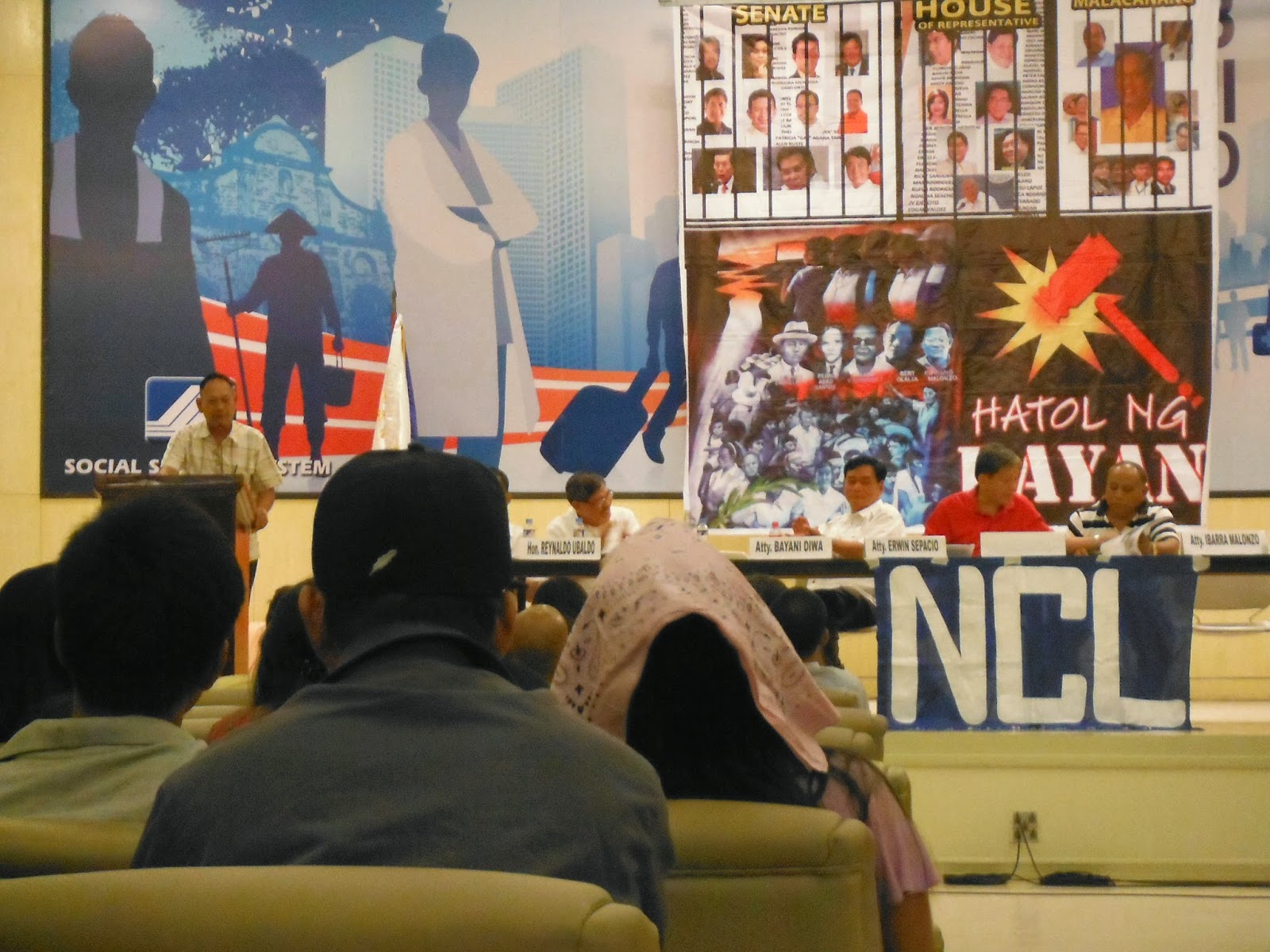
Pinagpugayan sa ika-4 na Kongreso ng National Confederation of Labor (NCL) si Filemon "Ka Popoy" Lagman (Marso 17, 1953 - Pebrero 6, 2001), dating pangulo ng sosyalistang Bukluran ng Manggagawang Pilipino (BMP). Ito'y ginanap nitong Mayo 22, 2014 sa Magsaysay Hall ng SSS Bldg., sa East Avenue, Lungsod Quezon. Ang tema ng kongreso ng NCL ay "Sosyalistang Lipunan, Sagot sa Kahirapan".

Isa si Ka Popoy Lagman sa mga tagapagtatag ng NCL. Ang plaque ay tinanggap ni Ka Ronnie Luna, bise-presidente ng BMP. Pito pang magigiting na lider-manggagawa, kabilang ang tatlong abogado, na pawang tagapagtatag din ng NCL, ang nakatanggap ng plake ng pagkilala. At ito'y sina Atty. Ibarra Malonzo, Atty. Benjamin Alar, Atty. Gaston Taquio, Ka Dominador "Domeng" Mamangon, Ka Zosimo Carullo, Ka Rey Capa at Ka Angelito "Lolo" Mendoza.

Nauna rito'y nagbigay ng mensahe ng pakikiisa ang iba't ibang grupo ng paggawa, kabilang ang BMP, sa pamamagitan ng mainit na talumpati ni Ka Ronnie Luna, sa kongreso ng NCL.

Ulat at mga litrato ni Greg Bituin Jr.
Tinanggap ni Ka Ronnie Luna ang plake ng pagkilala kay Ka Popoy Lagman mula kina Atty. Arellano, pangulo ng NCL, at Glecy Naquita ng grupong Socialista at head ng secretariat ng NCL.
Nagbigay ng mensahe ng pakikiisa ang BMP, sa pamamagitan ni Ka Ronnie Luna, sa ika-4 na Kongreso ng NCL.
Naka-flash sa white board ang tema ng ika-4 na Kongreso ng NCL na "Sosyalistang Lipunan, Sagot sa Kahirapan"habang nagtatalumpati si Ka Ronnie Luna ng BMP.
Bahagi ito ng unang pahina ng 3-pahinang programa ng ika-4 na Kongreso ng NCL.
Bahagi ito ng ikalawang pahina ng 3-pahinang programa ng ika-4 na Kongreso ng NCL.

Linggo, Mayo 18, 2014

Konsyerto ng Pagpupugay kay Ka Popoy, UP Bahay ng Alumni, Abril 27, 2001

Balik-Tanaw sa Kasaysayan
 
Konsyerto ng Pagpupugay kay Ka Popoy, UP Bahay ng Alumni, Abril 27, 2001

Mula sa album na iniingatan ni Ka Jun Lacsa ng Teatro Pabrika, na kinunan ng litrato ni Greg Bituin Jr. para ilagay dito sa blog bilang bahagi ng kasaysayan. Naipresenta ang album na ito ng Teatro Pabrika sa kanilang reyunyon noong Mayo 10-11, 2014 sa Paradise Resort, Gen. Trias, Cavite.

Huwebes, Pebrero 6, 2014

Biyernes, Hunyo 21, 2013

Ang BMP sa panahon ni Ka Popoy - ni Pohlee Hernandez

Paunawa: Ang artikulong ito'y ambag sa aklat na BMP 20, na alay para sa ika-20 anibersaryo ng BMP sa 14 Setyembre 2013.

ANG BMP SA PANAHON NI KA POPOY
ni Pohlee C. Hernandez

Halos baguhan pa lang ako noon sa pederasyong United Workers of the Philippines o UWP na ngayon ay SUPER na o Solidarity of Union in the Philippines for Empowerment and Reform. Ang aking task ay gawaing edukasyon at paminsan-minsan ay gumagampan ng OD work. Ang narinig ko na isang mabigat na problema noong mga panahong iyon sa pederasyon ay CBA negotiation sa unyon ng Chivalry food sa Malabon. Ayaw na kasi ng management na makipag-negotiate dahil ang gusto niya ay isara ang kompanya at bayaran na lamang ng separation pay ang mga manggagawa. Mayroon din siyang offer sa pederasyon na halagang P300,000.00 para naman kumbinsihin ang pamunuan ng unyon na pumayag na sa gusto ng management.

Si Ginoong Amado Ching ang sugo ng management upang makipag-usap sa mga opisyales ng pederasyon at magpaliwanag na din ng plano ng management. Ang analisis dito ng mga top officers ng UWP ay pansamantala lang ang pagsasara dahil ang talagang layunin ng kapitalista ay mawala ang unyon. Sa puntong ito ay agad na ipinatawag ng National Executive Council ng pederasyon ang mga lider ng unyon upang ilatag ang plano ng management at maibaba ang analisis ng mga officers ng UWP. Nagkaisa ang pamunuan ng unyon at pederasyon na ipaglaban ang karapatan sa trabaho at sa CBA. Ilang beses na negotiation pero matigas ang kompanya sa kanyang stand. 

Sa pagkakataong ito ay inilapit na ng pederasyon sa BMP ang problema at sa pamamagitan ni ka Popoy ay isinalang ang tactics plan ng UWP, BMP at ng unyon. Sa Barrio Fiesta ginanap ang pag-uusap. Ang representante ng kapitalista ay si Mr. Ching at sa pederasyon naman ay ang Pangulo, Vice at si ka Popoy. Nagboluntaryo akong sumama na ang layunin ko ay makapulot ng karanasan sa negosasyon at syempre pa para makakain sa Barrio Fiesta.

Unang inihain ang sopas, sabi ko sa sarili ko, hindi ako nagkamali na sumama kasi totoo nga pala na masarap ang pagkain kasi sopas pa lang, ulam na. Di kaginsaginsa sa pagitan ng mga pag-uusap ay narinig ko na tumaas ang tinig ni ka Popoy. Ang mga binitiwan niyang kataga sa aking pagkakaalala eh ganito. "Subukan ninyo ng amo mo na isara ang pabrika at pati mga mata ninyo ay isasara ko." Naku po! Ito pala ang ka Popoy na naririnig ko. First time ko makadaupangpalad at makasalamuha si ka Popoy. Habang kumakain na ako ng main dish eh parang wala akong malasahan. Nanginginig ang aking daliri at umiikot ang aking mga mata. Ang iniisip ko ng mga sandaling iyon ay kung saan ako tatakbong palabas if ever na magkagulo.

Sinulyapan ko si Mr. Ching, namumutla rin siya at nanginginig din ang mga kamay. Nakita ko si ka Popoy na tumayo na at umalis na ng restawrant. Tinanong ni Mr. Ching sa aming Presidente kung sino si ka Popoy? Ang sagot ng aming Presidente ay lider ng ABB. Mga ilang linggo ang lumipas at ayun hindi na isinara ang kompanya at natuloy ang collective bargaining agreement negotiation sa Chivalry Food. Marami pang mga CBA nego na matagumpay na nairaraos ng mga panahong iyon na kabalikat ng UWP ang pamunuan ng BMP.

Nagkaroon din noon ng internal problem sa loob ng pederasyon. Nagkanya-kanyang grupo ang mga ilang personahe. May hibo ng pag-aagawan ng liderato, may mga character assassination na sa bawat isa. Nang makaabot ito sa kaalaman ng pamunuan ng BMP ay kagyat na ipinatawag ang mga ilang susing lider. Pinagharap-harap. Makalipas ang ilang panahon at bumalik ang dating lakas, tatag at ipinagpatuloy ang pagpapalawak sa hanay ng UWP.

Ang aking obserbasyon ay muli kaming naging inspirado na magpatuloy sa mga gawain sa loob at labas ng UWP. Ang taas ng momentum ng mga manggagawa. Ramdam ang Labor Power. Halos lahat ng ipinutok na welga ay nagtagumpay. Iyon ang aking mga alaala sa panahon ng pamumuno ni ka Popoy sa BMP. 

Noong mag-umpisa na naman na magkaroon ng internal problem sa SUPER, lagi-laging pumapasok sa isip ko na nangyari na ito noon at pareho din ang kahahantungan na maisasaayos din ang lahat. Pero bigo ako, hindi nangyari ang aking inaasahan. Taon pa ang binilang at sa dulo ay ginanap pa ang ispesyal na Kongreso. Hanggang ngayon ay mayroon pa din na mga banta ng pagkawasak sa aming pederasyon. Tanong lang, kung ito kaya ay nangyari noon na ang namumuno sa BMP ay si ka Popoy, maibabalik kaya ang sigla, lakas at katatagan ng SUPER? Mapaparusahan kaya ang mga taong gumagawa ng katampalasanan sa organisasyon para sa kanya-kanyang personal na interes?

Ang lahat ng ito ay mananatili na lamang sigurong mga katanungan na aking aalalahanin tuwing sasapit ang anibersaryo ng BMP. Isang mapagpalayang pagbati sa ika-20 anibersaryo ng Bukluran ng Manggagawang Pilipino!

06 Hunyo 2013

Lunes, Pebrero 11, 2013

Ka Popoy Remembered - by Merk Maguddayao - from Interaksyon.com


KA POPOY REMEMBERED | Inspiring Filipino workers 12 years after his death
By: Merk Maguddayao
February 10, 2013 7:04 AM

http://www.interaksyon.com/article/54713/ka-popoy-remembered--inspiring-filipino-workers-12-years-after-his-death

InterAksyon.com
The online news portal of TV5

Merk Maguddayao is a cultural activist with the Sanlakas bloc and a founding member of Laya Sining. The views he expresses here are entirely his. 

Mentioning the name Popoy Lagman will draw mixed reactions from people who know him or of him.

To those he led and influenced, he was maverick master of polemics who never minced words in attacking the political follies of his party and comrades. He was fear-inspiring leader of the Alex Boncayao Brigade (ABB), the dreaded Manila-based communist militia known for its vigilante operations against “enemies of the masses." He was also the tireless and feisty working-class leader who fought for socialism as an alternative to capitalism.

The man headed the communist movement in Metro Manila during Martial Law and later defected from the Communist Party of the Philippines (CPP) after rejecting its Maoist and Stalinist orientation. He then formed an alternative Marxist movement that put premium on the emancipation of the working class and the formation of a workers-led government. He was felled down by an assassin’s bullet 12 years ago.

A dozen years hence, it is still uncertain who ordered his murder.

But for his close comrades at the Bukluran ng Manggagawang Pilipino (BMP), the labor federation he formed immediately after the split from the CPP in the early 1990s, who killed him does not matter anymore.

“Hindi makakamit ang hustisya para kay Ka Popoy sa simpleng paghahanap sa kung sino-sinong pumatay sa kanya (There will be no justice for Ka Popoy in the simple search for those who killed him),” explained Victor Briz, a long-time leader of BMP from Southern Metro Manila.

“Wala tayong inaasahang pagpupursigi mula sa ating gobyerno para makamit iyan. Ang tunay na hustisya para kay Ka Popoy ay makakamit lamang sa paglaya ng uring manggagawa (We cannot rely on any effort from the government to get that. The real justice for Ka Popoy will only be achieved in the liberation of the working class),” he said.

Here lies the Filemon “Ka Popoy” Lagman’s indelible legacy in history: He fought for neither his personal nor organizational gains per se. He stood for the class interest of the Filipino workers, and the workers of the world in general. He was not content in merely serving the people, or fighting merely for the liberation of the Philippines from US imperialism, or even in simply toppling a corrupt and incompetent president only to be replaced by other members from the elite class. He pushed for socialism, a system wherein political and economic power lies in the hands of the workers.

Prescience

Despite being “abrasive, harshly polemical, and brutally frank” (as his close companions described him), and much to the chagrin of the Jose Ma. Sison-led CPP, Ka Popoy was a Filipino revolutionary with a profound ideological sharpness and sincerity. At the risk of being “disciplined,” including the penalty of death, he did not shirk from criticizing the dogmatic strategy and tactics of the CPP, and later the adventurist tendencies of the post-split ABB.

He may not have had the biggest number of followers in the Philippine Left, but history has proven that the political line of his bloc has been consistently correct and prescient. These included the participation of the Manila-Rizal unit of the CPP in the 1978 Interim Batasang Pambansa elections, when the CPP central leadership called for boycott; the participation of CPP-led forces in the first EDSA Revolution, when the CPP insisted on its militarist strategy; the campaign against economic globalization in 1990s which resulted in trade liberalization, labor contractualization, and privatization of key industries in the Philippines and which in 2007 resulted in the still-raging global financial crisis; and at the tail end of his life, the “Resign All” call in EDSA II at a time when everybody called for Gloria Macapagal-Arroyo to replace the beleaguered Joseph Estrada.

Spending more than 30 years in the revolutionary movement, Ka Popoy’s prescience was founded not on whims but was a result of his vigor in mastering scientific socialism and dialectical materialism, his tool of analysis in assessing local, national, and even international situations. He did not parrot or copy-paste abstract dogmas and set them as solutions for all situations.

His ideological wizardry culminated in the publication of the Counter Thesis documents that unmasked the CPP’s dogmatic and unscientific and unrealistic program of protracted people’s war and the struggle for national democracy -- a document that has never been officially answered by the CPP up to this day.

Renewal and redemption

Under Ka Popoy’s leadership, a new batch of activists were recruited to the Left after the split and a renewed call for radical change ushered in what Sonny Melencio, Ka Popoy’s long-time comrade and current chairman of the Partido Lakas ng Masa, termed as the “Second Period” in the Philippine Left.

This new batch, popularly called “Rejectionists” (or RJ, although the RJs would later further divide into more contending blocs), primarily defined themselves as revolutionary socialists, combined various forms of struggles and revolutionary tactics, and opened its doors to various forces in society, thus eschewing the sectarianism of the old.

After Ka Popoy’s death, the Philippine revolutionary movement may still be divided, and people may say that it has weakened, but the worldwide crisis of the capitalist order has worsened. As Ka Popoy predicted in 1999, “Globalization by its very nature transforms the economic turmoil in one nation into a world crisis.”

Despite the political ebb of the Philippine Left under the PNoy administration and the continuous backwardness of Philippine society, Ka Popoy's forecast offers a word of hope for those who desire for systemic change to usher in a humane world: “The first decade of the new millennium will be the eve of the socialist revolution in the era of globalization.”

Currently, the socialist movement is gaining strength in Latin America, with the establishment of socialist-led governments in Venezuela and Bolivia, the popularization of Left politics in other Latin American states, and the increasing protests in the United States, Europe, and the Middle East against the bankruptcy of the rule of the 1 percent.

The struggle for radical change might be far from over, and Ka Popoy would never have the chance to witness what he called “the Armageddon of capitalism,” but for as long as the exploitation of the many by the elite few exists, Ka Popoy’s determination and tenacity for change will continue to inspire the powerless.